
Every stadium hosting the 2026 FIFA World Cup
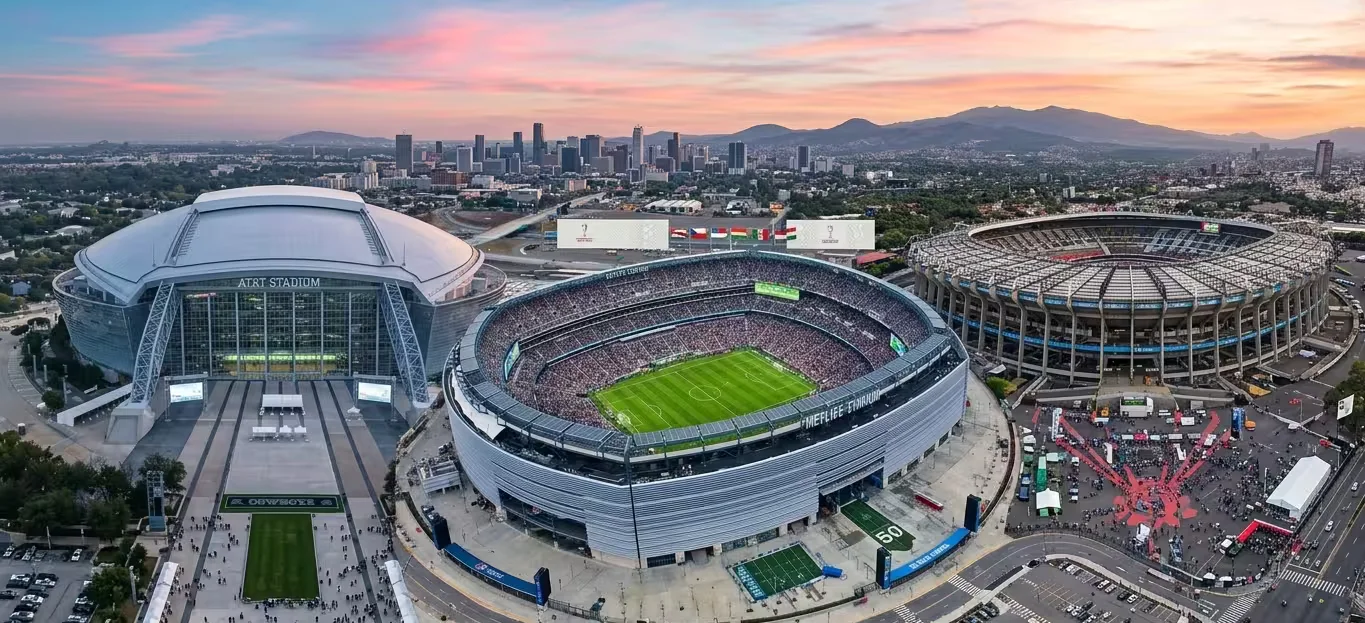
For the first time in history, the 2026 FIFA World Cup tournament will be hosted by three countries, the United States, Canada, and Mexico, while expanding to 48 teams and a staggering 104 matches across 39 days.
To stage the biggest World Cup ever, FIFA selected 16 stadiums spread across North America. Some are historic football landmarks. Others are ultra-modern architectural masterpieces worth billions of dollars.
Beyond aesthetics, these venues could significantly shape the tournament itself. Heat, altitude, travel distances, pitch conditions, and even stadium design may influence performances as nations battle for football’s ultimate prize.
Here’s a complete breakdown of every stadium hosting the 2026 FIFA World Cup.
Which stadium will host the 2026 World Cup Final?
The World Cup final will be played at New York New Jersey Stadium - MetLife Stadium on July 19, 2026.
![[object Object]](https://cdn.sanity.io/images/5gkjmhor/production/bf0a068e601dbfde5e353c4d89952963cfa3a4df-1280x785.heif?rect=0,22,1280,684&fm=webp&q=85&fit=max&auto=format)
MetLife Stadium
Located in East Rutherford, New Jersey, just outside Manhattan, the venue is the largest stadium at the tournament with a FIFA capacity of 78,576. The stadium beat Dallas Stadium to secure hosting rights for football’s biggest match.
Which stadium will host the most matches?
Dallas Stadium - AT&T Stadium will host nine matches, more than any other venue at the tournament. The stadium, home of the NFL’s Dallas Cowboys, will also stage one of the semi-finals.
![[object Object]](https://cdn.sanity.io/images/5gkjmhor/production/42fc9c55b71e3158ebebf201122afff28e837dfb-1778x1000.heif?rect=0,135,1778,722&fm=webp&q=85&fit=max&auto=format)
AT&T Stadium
With air conditioning and a retractable roof, it could become one of the most comfortable venues for players despite Texas’ intense summer temperatures.
Historic World Cup venues returning in 2026
Estadio Azteca — Mexico City
No stadium in World Cup history carries more football mythology than Estadio Azteca. The iconic venue hosted:
- Pele’s Brazil lifting the 1970 World Cup
- Diego Maradona’s “Hand of God” and “Goal of the Century” in 1986
In 2026, Azteca will become the first stadium ever to host matches at three separate men’s FIFA World Cups. Its altitude of over 2,200 metres could once again become a major factor for visiting teams.
The most advanced stadium at the World Cup 2026
Los Angeles Stadium (SoFi Stadium)
At a reported cost of $5.5 billion, SoFi Stadium is the most expensive stadium ever built. The futuristic venue combines indoor and outdoor architecture with:
- A giant translucent canopy
- Earthquake-resistant construction
- A suspended double-sided 4K “Infinity Screen.”
![[object Object]](https://cdn.sanity.io/images/5gkjmhor/production/2b251bc1010ac469f3d628296142805b88d954b3-1800x1200.heif?rect=0,0,1800,976&fm=webp&q=85&fit=max&auto=format)
The stadium sits partially underground because of nearby airport height restrictions. It will host eight World Cup matches, including key USA fixtures.
Which World Cup cities could have extreme heat?
The weather may become one of the biggest talking points during the tournament.
Hottest Venues Expected
- Miami
- Monterrey
- Houston
- Dallas
Miami, in particular, is expected to challenge players with extreme humidity and temperatures above 30°C. Unlike Dallas, Houston, and Atlanta, which have retractable roofs and climate control, Miami Stadium is open-air.
Even night matches may remain physically demanding.
Cooler World Cup Venues
Teams looking for relief from the heat may welcome fixtures in:
- Vancouver
- Seattle
- Toronto
These cities are expected to offer much milder conditions during June and July. Seattle and Vancouver are particularly important because they reduce environmental strain on players during the expanded tournament schedule.
Stadiums using temporary grass pitches
One major talking point before the World Cup concerns artificial turf. Eight venues normally use synthetic surfaces, including:
- Atlanta
- Dallas
- Houston
- Los Angeles
- Seattle
- Vancouver
- Boston
- New Jersey
FIFA regulations require natural grass for World Cup matches, meaning temporary pitches will be installed.
Concerns emerged during the 2025 FIFA Club World Cup when players criticised the quality of temporary surfaces, with PSG manager Luis Enrique famously saying the ball “bounced like a rabbit” in Seattle. FIFA insists those issues will be solved before 2026.
Canada’s World Cup Stadiums
Toronto Stadium (BMO Field)
Toronto will host Canada’s opening match and six games overall. Temporary seating expansions will raise capacity significantly for the tournament.
BC Place — Vancouver
Vancouver’s BC Place features the world’s largest cable-supported retractable roof. The city is expected to provide some of the coolest weather conditions at the tournament.
Mexico’s Other Host Stadiums
Estadio Guadalajara (Estadio Akron)
Built to resemble a volcano, Guadalajara’s stadium combines striking architecture with high-altitude playing conditions.
Estadio Monterrey (Estadio BBVA)
Located near the US border, Monterrey may become the hottest venue of the tournament, with temperatures capable of exceeding 34°C.
Major US Venues to Watch
Atlanta Stadium (Mercedes-Benz Stadium)
Features a spectacular retractable roof inspired by the Pantheon in Rome.
Kansas City Stadium (Arrowhead Stadium)
One of the loudest stadiums in world sport thanks to crowd acoustics designed to amplify noise.
Philadelphia Stadium (Lincoln Financial Field)
Known for its environmentally friendly design powered partly by solar energy.
Boston Stadium (Gillette Stadium)
Home of the New England Patriots and site of several iconic football moments dating back to USA 1994.
San Francisco Bay Area Stadium (Levi’s Stadium)
Located in Silicon Valley, the venue recently underwent major upgrades ahead of the World Cup.
Why World Cup 2026 could feel different
This tournament will stretch across:
- Four time zones
- Three countries
- Thousands of miles of travel
That scale creates challenges never seen before in World Cup history. Teams will need to adapt not just tactically, but physically:
- Heat management
- Altitude adaptation
- Recovery scheduling
- Long-distance travel
The venues themselves may ultimately shape the destiny of the tournament.
From the historic walls of Estadio Azteca to the futuristic brilliance of SoFi Stadium, the 2026 FIFA World Cup promises a visual and sporting spectacle unlike anything football has seen before.
With 48 nations competing across North America, every stadium will become part of football history. The countdown to the biggest World Cup ever has officially begun.

SportsLigue