Sabastian Sawe makes history with Sub-2 London Marathon win
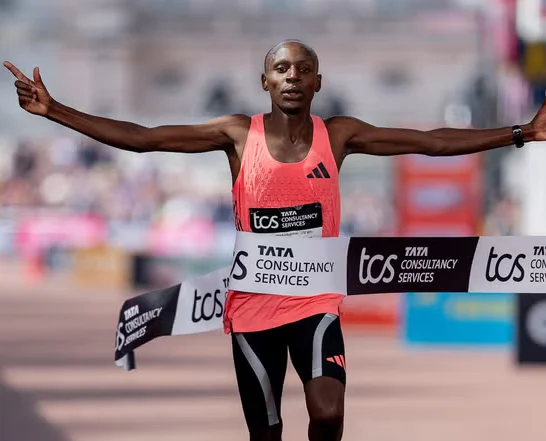
Sabastian Sawe made athletics history at the London Marathon by becoming the first athlete to run a sub-two-hour marathon in a record-eligible race. The Kenyan crossed the line in 1:59:30, beating the previous official record of 2:00:35 set by the late Kelvin Kiptum in 2023.
The result was a landmark moment for road running, not only because Sawe won the race, but because his time broke a barrier long thought to be beyond reach in competition. The performance also came in a field that produced several other remarkable results, including a women-only world record by Tigst Assefa and dominant wheelchair wins by Marcel Hug and Catherine Debrunner.
Sawe’s record run
Sawe had already signalled his form by passing halfway in 1:00:29 and then accelerating over the second half to finish even faster than expected. He moved decisively before the final 10 kilometres, with Yomif Kejelcha the only runner able to stay close as the pace lifted.
His final time of 1:59:30 gave him a margin of 11 seconds over Kejelcha, who also broke the two-hour barrier in 1:59:41 on marathon debut. Jacob Kiplimo completed the podium in 2:00:28, a time that was itself quicker than Kiptum’s previous official world record.
Why the time matters
Eliud Kipchoge famously ran under two hours in 2019, but that effort was not record-eligible because it was staged under controlled conditions rather than in a conventional race. Sawe’s performance was different: it came in an official marathon, under race rules, and therefore stands as a historical first.
That distinction is important in athletics because it separates an inspirational exhibition from a performance that can be formally recorded, compared, and ratified. Sawe’s run therefore changes the benchmark for what is possible in a competitive marathon.
How the race unfolded
The conditions in London suited fast racing, and Sawe used them to produce a sharply negative split, covering the first half in 60:29 and the second in 59:01. His closing kilometres were especially strong, including a 13:54 segment from 30-35km and a 13:42 split from 35-40km, underlining how controlled and aggressive the effort was.
Former world champion Steve Cram described the performance as one of those rare sporting moments fans want to witness live, while Paula Radcliffe said the “goalposts” for marathon running had changed. Mo Farah also called it an incredible moment, reflecting the scale of the achievement.
Assefa and the wheelchair races
Tigst Assefa also produced a headline performance by winning the women’s race in 2:15:41, improving her own women-only world record by nine seconds. She held off Hellen Obiri and Joyciline Jepkosgei in a competitive finish to retain her London title.
In the wheelchair events, Marcel Hug won the men’s race for a record-equalling eighth London Marathon title, while Catherine Debrunner retained the women’s crown after edging Tatyana McFadden in the closing stages. Both results added to a day that delivered elite performances across the board.
What this means
Sawe’s result will likely reset how coaches, athletes, and fans think about the elite marathon standard. His pace, race execution, and finishing strength suggest that the sub-two-hour barrier in competition is no longer theoretical but achievable under the right conditions.
It also raises the level of expectation for major city marathons, especially London, Berlin, and other courses known for fast times. With Sawe, Kejelcha, and Kiplimo all finishing faster than the old record, the men’s marathon appears to be entering a new performance era.
Tags

SportsLigue