Why Wimbledon Women's Champions lift a plate instead of a trophy
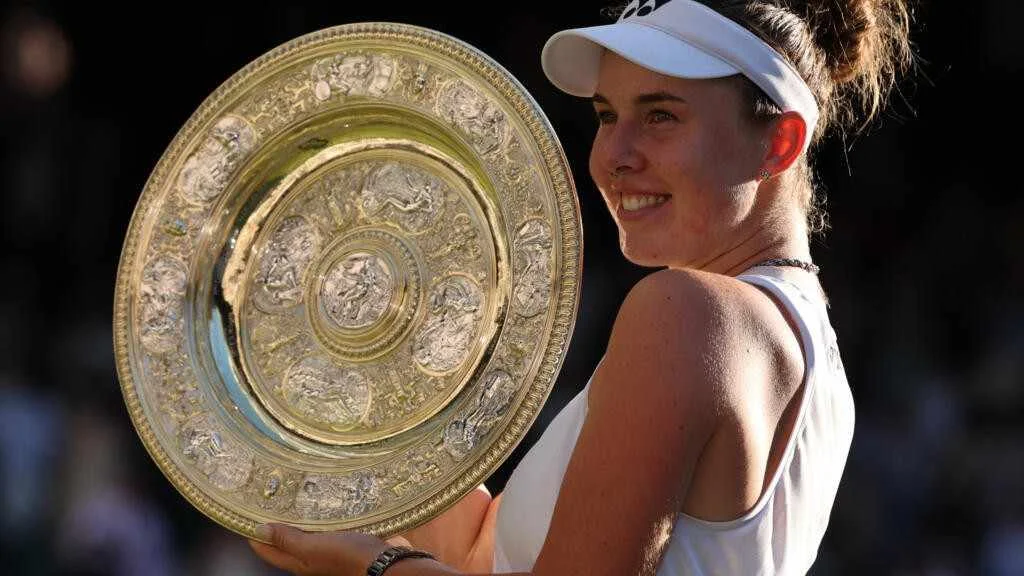
Every July, Wimbledon crowns two singles champions on Centre Court. Yet while the men's winner lifts a traditional gold trophy, the women's champion celebrates with an ornate silver dish known as the Venus Rosewater Dish.
For first-time viewers, the contrast often raises an obvious question: Why does the women's champion receive what looks like a giant plate instead of a trophy? The answer has little to do with prestige and everything to do with Wimbledon tradition.
The Venus Rosewater Dish: Wimbledon’s Historic Women's Prize
The official trophy awarded to the Wimbledon women's singles champion is called the Venus Rosewater Dish. Although many fans simply refer to it as "the plate," it is actually one of the oldest and most recognizable championship prizes in world sport.
The silver salver has been presented to Wimbledon women's champions since 1886, just two years after the ladies' singles event was introduced. Unlike many sporting trophies that have changed over time, Wimbledon has preserved this tradition for well over a century.
Why is it a plate instead of a cup?
The difference reflects Victorian customs rather than any difference in sporting achievement. During the late 19th century, ornate silver tableware and decorative serving dishes were commonly presented as prestigious awards, particularly in women's competitions.
When Wimbledon established the ladies' championship, organizers chose an elaborate silver salver that reflected the artistic tastes and ceremonial traditions of the era.
A year later, the men's championship adopted its own permanent silver-gilt cup after earlier "Challenge Cups" had been permanently awarded to multiple-time champions. The two trophies therefore evolved independently rather than being designed as matching awards.
Today, both prizes are considered equally prestigious.
Who designed the Venus Rosewater Dish?
The famous dish was produced in 1864 by renowned Birmingham silversmiths Elkington & Co. It is not an entirely original creation.
Instead, it reproduces a Renaissance-style design by German artist Caspar Enderlein, whose work itself was inspired by an earlier decorative basin created by French sculptor François Briot during the 16th century.
Its detailed craftsmanship remains one of the reasons the trophy is regarded as both a sporting prize and a work of art.
What is depicted on the dish?
The Venus Rosewater Dish is filled with classical symbolism. Among its most notable features are:
- Sophrosyne, the Greek figure representing moderation and wisdom
- Classical representations of Earth, Air, Fire, and Water
- Decorative Renaissance patterns
- The Seven Liberal Arts, including astronomy, music, rhetoric and geometry
These intricate engravings make the dish unlike any other championship trophy in tennis.
How big is the Venus Rosewater Dish?
The original trophy measures approximately 18.75 inches (47.5 cm) across, weighs around 2.3 kilograms and is crafted from sterling silver with gold detailing. Despite often being called a plate, it is significantly larger than standard serving ware and immediately recognizable during the trophy presentation.
Do Wimbledon Champions keep the original dish?
No. Just like the men's trophy, the original Venus Rosewater Dish never leaves the All England Club. Instead, champions receive a replica.
Since 2007, winners have been presented with a three-quarter-size replica, allowing them to take home a permanent reminder of their Wimbledon triumph while preserving the historic original.
How valuable is the Venus Rosewater Dish?
Because it is part of Wimbledon history, assigning an exact monetary value is virtually impossible. Its worth extends far beyond the value of its silver.
As one of the oldest continuously awarded trophies in professional sport, it represents generations of champions, from legends such as Martina Navratilova, Steffi Graf and Serena Williams to modern stars like Marketa Vondrousova, Barbora Krejcikova and Linda Noskova.
For Wimbledon, its historical significance makes it effectively priceless.
In an era when many sporting competitions have redesigned their trophies, Wimbledon has deliberately preserved its unique traditions. The contrast between the Gentlemen's Singles Trophy and the Venus Rosewater Dish has become one of the tournament's defining characteristics.
Although different in appearance, both prizes carry the same prestige. Winning either means joining one of the most exclusive groups in tennis history, a Wimbledon singles champion.
Tinu Brown
Related Posts

What is the Coupe des Mousquetaires?
June 3, 2026

What is the Coupe Suzanne Lenglen?
June 2, 2026