Nigeria’s Flamingos rewrite history with first African Women’s FIFA World Cup Title
For generations, African women’s football has produced talented players and competitive national teams, but a FIFA World Cup title remained beyond the continent’s reach. Nigeria’s Flamingos have now changed that history.
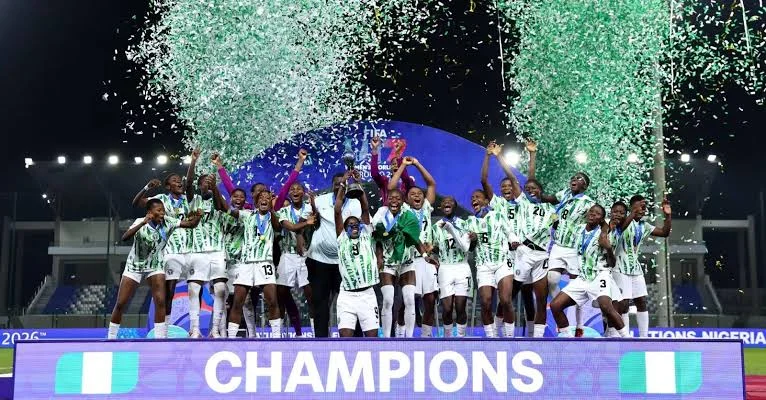
On Saturday, November 7, 2026, Nigeria’s U-17 women’s national team defeated Japan 2–1 in the final of the FIFA U-17 Women’s World Cup in Morocco, becoming the first African nation to win the competition.
The achievement carries significance beyond the age-grade trophy. The Flamingos have become the first African women’s national team to win a FIFA World Cup title at any level, delivering a landmark moment for Nigerian football and the wider continent.
Goals from Awawu Bashiru and Oluebube Umejiaku gave Nigeria a two-goal advantage in Rabat. Bashiru opened the scoring in the 39th minute before Umejiaku doubled the lead two minutes into the second half.
Japan threatened a late comeback when Fuki Ito scored in the 80th minute, but Nigeria held on through the closing stages to secure a historic victory.
It was the culmination of a campaign defined by resilience, collective effort and the ability to respond when the odds appeared to be turning against them.
From opening defeat to world champions
The Flamingos did not begin the tournament as champions-elect. Their campaign opened with a 2–1 defeat to Poland, an early setback that placed immediate pressure on the Nigerian side.
Rather than allow that result to undermine their confidence, the players responded with six consecutive victories to lift the trophy.
Nigeria recovered with a 2–0 win over Puerto Rico before producing a major statement against defending champions Korea DPR, defeating the Asian side 3–1. The result demonstrated that the Flamingos could compete with the tournament’s strongest teams and gave their campaign renewed momentum.
Their progress continued in the knockout rounds, where they defeated Mexico 2–1 in the Round of 16. Nigeria then edged Venezuela 1–0 in the quarter-finals, with Azeezat Oduntan converting an 89th-minute penalty to secure a place in the last four.
The semi-final against Brazil presented another demanding challenge, but Nigeria produced one of their strongest performances of the competition.
Queen Joseph opened the scoring in the 56th minute before Awawu Bashiru struck twice, in the 71st and 80th minutes, to put the Flamingos in control. Brazil managed a late goal, but Nigeria's 3–1 victory confirmed their place in a first-ever U-17 Women’s World Cup final.
By the time they faced Japan, the Nigerian team had transformed an opening-day disappointment into a run of victories that placed them within reach of history.
Japan final delivers a historic breakthrough
The final in Rabat provided the Flamingos with an opportunity to turn their impressive tournament run into a continental milestone.
Nigeria started with attacking intent and created several opportunities before Bashiru broke the deadlock in the 39th minute. Her effort caused problems for Japan goalkeeper Kou Kadowaki, who was unable to keep the ball out.
The second goal arrived shortly after the restart. Esther Stephen played a forward pass that released Umejiaku, who controlled the ball before delicately lifting it over the advancing goalkeeper in the 47th minute.
Japan refused to surrender, however. Fuki Ito pulled one back in the 80th minute, setting up a tense finish as the Japanese players pushed for an equaliser.
The Nigerian defence remained organised under pressure, protecting the advantage until the final whistle.
Umejiaku’s contribution was particularly significant, with her goal in the final helping secure Nigeria’s maiden title in the competition. The victory also confirmed the Flamingos as pioneers in African women’s football.
A new chapter in Africa’s football history
The Flamingos’ achievement adds a significant milestone to the history of African football at FIFA youth competitions.
Nigeria had previously finished third at the FIFA U-17 Women’s World Cup in 2022, but had never reached the final before this year’s tournament. The 2026 triumph therefore represents the country’s first title in the competition and Africa’s first.
At the U-20 Women’s World Cup, Nigeria have twice reached the final, finishing runners-up in 2010 and 2014. Those campaigns demonstrated the country's ability to produce competitive teams at youth level, even though the ultimate prize remained elusive.
African football has also recorded notable successes in other age-grade competitions. Ghana won the men's FIFA U-20 World Cup in 2009, while Morocco claimed the men's U-20 title in 2025.
At senior level, Morocco’s run to the semi-finals of the 2022 FIFA World Cup remains the best performance by an African men's national team. In the Women’s World Cup, Nigeria and Cameroon have both reached the quarter-finals, in 1999 and 2015 respectively.
The Flamingos have now added a different kind of breakthrough: an African women's national team winning a FIFA World Cup title.
Their victory is evidence of the potential within the continent’s women’s game and offers a powerful example of what sustained youth development can achieve.
A homecoming worthy of world champions
The significance of the triumph was clear when the Flamingos returned to Nigeria on Monday, November 9, with the trophy.
The players arrived at the Nnamdi Azikiwe International Airport in Abuja to a celebratory reception, as supporters, officials and well-wishers gathered to welcome the newly crowned world champions.
The celebrations continued at the State House, where First Lady Senator Oluremi Tinubu received the team and technical officials on behalf of President Bola Tinubu.
The Federal Government subsequently announced financial rewards in recognition of the historic achievement.
Each player was awarded a ₦100 million savings certificate, with the funds set aside to protect the young footballers’ financial interests. Head coach Akeem Busari was awarded ₦100 million in cash, while members of the technical crew were allocated ₦50 million each.
The rewards represented official recognition of the players’ efforts and the importance of their achievement. However, the bigger question is how Nigeria can convert the excitement surrounding the victory into lasting investment in women's football.
Turning a historic victory into lasting progress
The Flamingos have demonstrated that African players can compete with and defeat established football nations on the biggest youth stage. The challenge now is to ensure that this success becomes part of a wider development strategy rather than a moment celebrated and quickly forgotten.
That responsibility rests with football administrators, particularly the Nigeria Football Federation, as well as the wider sporting community.
Young players need more than occasional recognition. They require consistent access to quality coaching, competitive leagues, modern training facilities, sports science, medical support and appropriate welfare structures.
The transition from youth football to the senior game is especially important. Players who excel at under-17 level must be given opportunities to develop physically, technically and tactically without being rushed or left without a clear pathway.
For Nigeria, the Flamingos could provide an important talent base for the future of the Super Falcons. However, that progression will depend on careful player development, continued competition and the support required to help the youngsters adapt to the demands of senior international football.
The success should also encourage other African football associations to strengthen their women's youth programmes. The talent exists across the continent, but turning it into international success requires long-term planning and sustained investment.
The Flamingos have opened a new door
Nigeria’s victory over Japan will be remembered as more than a successful final. It marked the moment an African women's national team finally claimed a FIFA World Cup title.
The Flamingos overcame an opening defeat, defeated some of the strongest teams in the competition and showed the composure required to finish the job against Japan.
Their achievement has brought pride to Nigeria, inspired young girls across Africa and provided a new reference point for what the continent can accomplish in women's football.
The celebrations will eventually fade, but the responsibility to build on this success will remain.
For the Flamingos, the trophy is a reward for an extraordinary campaign. For Nigeria and African women's football, it should be the foundation for something even greater.

SportsLigue