The Meisterschale Explained: History, Design and Bundesliga Champions
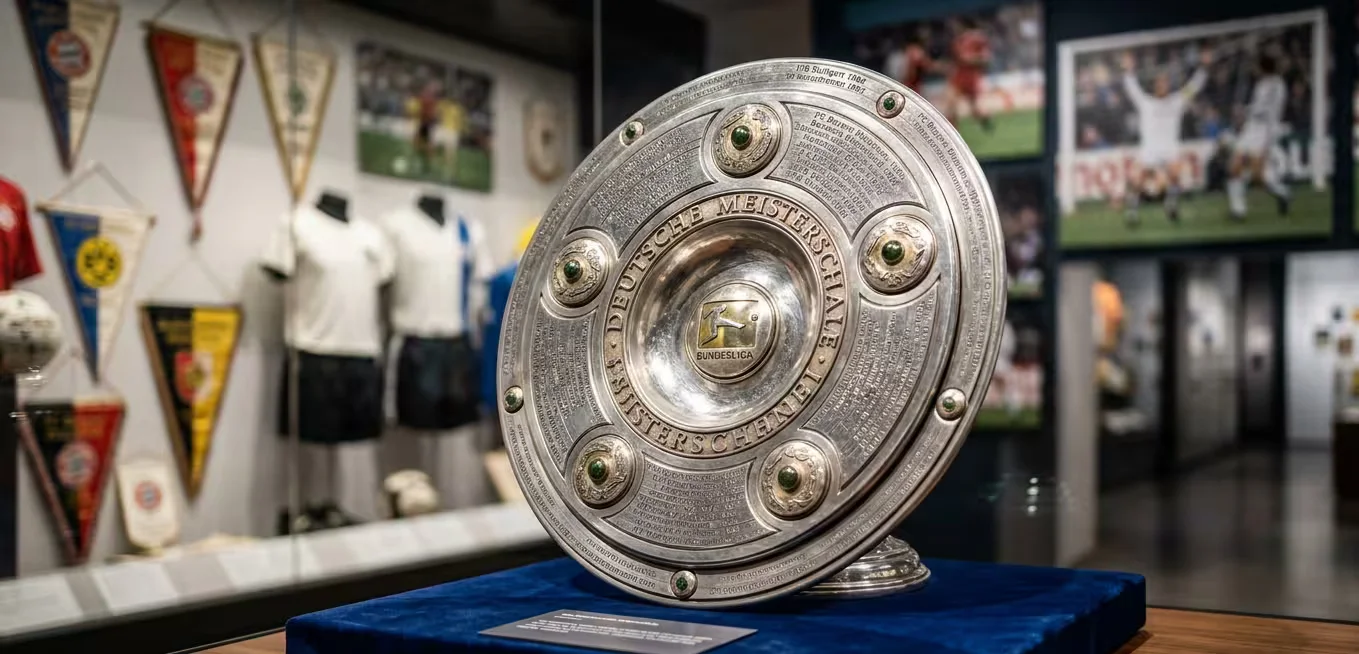
Bayern Munich were crowned champions of the Bundesliga once again in the 2024/25 season, lifting their record-extending 33rd title. But beyond the celebrations lies one of football’s most unique pieces of silverware, the Meisterschale.
Often referred to simply as the Bundesliga trophy, the Meisterschale carries a rich history that reflects the evolution of German football itself.
What is the Meisterschale?
The Meisterschale, literally translated as “champions’ bowl,” is the official trophy awarded to the winners of Germany’s top-flight league.
Despite the Bundesliga being founded in 1963, the trophy itself dates back further. It was introduced in 1949 to replace the Viktoria statue, which had been lost during World War II. Since then, it has been awarded to every German champion, linking modern winners to the earliest eras of the game.
Designed by German artist Elisabeth Treskow, the shield features engraved names of champions dating as far back as VfB Leipzig in 1903.
Design, Weight, and Unique Features
The Meisterschale stands out from traditional football trophies with its circular, shield-like design, earning it the nickname “salad bowl.”
Key details include:
- Weight: 11 kilograms
- Material: Silver with embedded gemstones
- Stones: Tourmalines set in gold
- Engravings: Every German champion since 1903
As more clubs won the title, space became an issue. In 1981, an additional silver ring was added to accommodate future champions, ensuring the trophy could continue evolving alongside the league.
How the Trophy is awarded
Unlike some competitions, the Bundesliga trophy presentation is carefully planned but flexible. In seasons where the title race is decided early, as with Bayern in 2024/25, the ceremony is straightforward. However, when multiple teams are still in contention on the final day, league organizers prepare duplicate trophies.
The original Meisterschale is sent to the team leading the table, while a replica is positioned at other potential title-winning venues. This ensures that whichever club clinches the title can celebrate immediately.
Celebration Traditions
Winning the Meisterschale is only the beginning of the celebrations. One of the most iconic traditions is the “Bierdusche,” a post-match ritual where players drench each other in beer. In Munich, Bayern players and fans typically gather at Marienplatz to celebrate together, turning the city centre into a sea of red.
Bundesliga Champions: A League of Dominance and Surprises
Since the Bundesliga’s inception in 1963, only 13 different clubs have won the title, a reflection of both competition and dominance within German football. Bayer Leverkusen became the latest new champion in 2023/24, completing an unbeaten season under Xabi Alonso, one of the most remarkable campaigns in league history.
Still, the competition has largely been defined by Bayern Munich’s supremacy. Their 33 titles place them far ahead of rivals like Borussia Dortmund, Werder Bremen, and Hamburger SV.
Historic moments across the decades
The Bundesliga’s history is filled with defining eras:
- 1970s: Borussia Mönchengladbach and Bayern Munich dominate
- 1990s: Rise of Dortmund and Kaiserslautern’s famous title as a newly promoted side
- 2000s–2020s: Bayern’s sustained dominance, including multiple title streaks
Legendary players like Gerd Müller, Robert Lewandowski, and Jürgen Klopp (as a coach) have all shaped the league’s story.
Latest Champions
- 2023/24: Bayer Leverkusen (first title, unbeaten season)
- 2024/25: Bayern Munich (33rd title)
Bayern’s latest triumph under Vincent Kompany further reinforces their status as the defining force in German football.
Full List of Bundesliga Champions (1963–Present)
1960s
- 1963/64 – 1. FC Cologne
- 1964/65 – Werder Bremen
- 1965/66 – TSV 1860 Munich
- 1966/67 – Eintracht Braunschweig
- 1967/68 – 1. FC Nuremberg
- 1968/69 – Bayern Munich
- 1969/70 – Borussia Mönchengladbach
1970s
- 1970/71 – Borussia Mönchengladbach
- 1971/72 – Bayern Munich
- 1972/73 – Bayern Munich
- 1973/74 – Bayern Munich
- 1974/75 – Borussia Mönchengladbach
- 1975/76 – Borussia Mönchengladbach
- 1976/77 – Borussia Mönchengladbach
- 1977/78 – 1. FC Cologne
- 1978/79 – Hamburger SV
- 1979/80 – Bayern Munich
1980s
- 1980/81 – Bayern Munich
- 1981/82 – Hamburger SV
- 1982/83 – Hamburger SV
- 1983/84 – VfB Stuttgart
- 1984/85 – Bayern Munich
- 1985/86 – Bayern Munich
- 1986/87 – Bayern Munich
- 1987/88 – Werder Bremen
- 1988/89 – Bayern Munich
- 1989/90 – Bayern Munich
1990s
- 1990/91 – 1. FC Kaiserslautern
- 1991/92 – VfB Stuttgart
- 1992/93 – Werder Bremen
- 1993/94 – Bayern Munich
- 1994/95 – Borussia Dortmund
- 1995/96 – Borussia Dortmund
- 1996/97 – Bayern Munich
- 1997/98 – 1. FC Kaiserslautern
- 1998/99 – Bayern Munich
- 1999/2000 – Bayern Munich
2000s
- 2000/01 – Bayern Munich
- 2001/02 – Borussia Dortmund
- 2002/03 – Bayern Munich
- 2003/04 – Werder Bremen
- 2004/05 – Bayern Munich
- 2005/06 – Bayern Munich
- 2006/07 – VfB Stuttgart
- 2007/08 – Bayern Munich
- 2008/09 – VfL Wolfsburg
- 2009/10 – Bayern Munich
2010s
- 2010/11 – Borussia Dortmund
- 2011/12 – Borussia Dortmund
- 2012/13 – Bayern Munich
- 2013/14 – Bayern Munich
- 2014/15 – Bayern Munich
- 2015/16 – Bayern Munich
- 2016/17 – Bayern Munich
- 2017/18 – Bayern Munich
- 2018/19 – Bayern Munich
- 2019/20 – Bayern Munich
2020s
- 2020/21 – Bayern Munich
- 2021/22 – Bayern Munich
- 2022/23 – Bayern Munich
- 2023/24 – Bayer Leverkusen
- 2024/25 – Bayern Munich
Why the Meisterschale matters
More than just a trophy, the Meisterschale is a symbol of legacy. Every engraved name represents a chapter in German football history, making it one of the few trophies that physically carries over a century of champions.
For players and clubs alike, lifting it means more than winning a title; it means becoming part of a story that stretches back generations.
Tinu Brown