Arsenal hold Atletico Madrid to 1-1 draw in UCL semifinal first leg
Arsenal and Atletico Madrid emerged from the Metropolitano on Wednesday night with a 1-1 draw in the Champions League semi‑final first leg, preserving both teams’ dreams of a first‑ever European Cup while offering a stark contrast to the chaotic 5-4 shootout between PSG and Bayern that had lit up the competition the night before.
Julian Alvarez converted a penalty early in the second half to cancel out Viktor Gyökeres’ spot‑kick just before half‑time, and the next 70 minutes unfolded as a tense, low‑score, high‑stakes chess match rather than a shootout of chances.
The stalemate leaves Arsenal perfectly placed to reach the final in Budapest for the first time since 2006, while Atletico will believe the tie is still theirs to win at home if they can shift the balance in the second leg.
This was not the nine‑goal spectacle of the PSG‑Bayern classic; it was a game dominated by the fear of conceding, the stubbornness of compact defensive blocks, and the weight of 120 years of European history that both clubs have still never converted into a major European title.
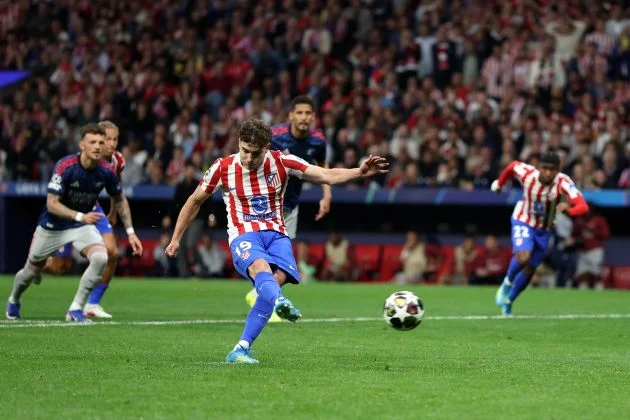
Alvarez and Gyökeres exchange penalties
The match swung on two spot‑kicks, both rightly awarded but each accompanied by late‑decision drama. Viktor Gyökeres, stepping in as Arsenal’s central striker in Kai Havertz’s absence, put the Gunners ahead on the stroke of half‑time after he was barged from behind by David Hancko in the 18‑yard box. The referee pointed to the spot, and the Swedish striker kept his composure to thump the penalty past Jan Oblak.
Ten minutes into the second half, the pendulum swung the other way. Ben White, stretched and desperate, stuck out a hand as an Atletico counter‑attack broke towards the Arsenal box, and the referee awarded a penalty after a VAR check. Julian Alvarez, one of the Rojiblancos’ most important attacking threats all season, buried the resulting spot‑kick to level the scores.
Arsenal were further aggrieved late on when a second penalty decision was overturned after a VAR review. The ball fell to Eberechi Eze in the area, and contact with Hancko suggested a possible second foul; but upon review, the officials ruled it did not merit a penalty, prompting furious protests from the London bench. The sequence underlined the razor‑thin margins in a tie where a single goal could decide everything.
Metropolitan tension and the “no‑score, no‑foul” vibe
The Metropolitano set the tone long before kick‑off. Toilet paper rained from the stands, in a theatrical, wasteful prelude that drew some sarcasm from online observers about the quality of the spectacle to come. The display captured the intensity of the fixture, and perhaps the fans’ frustration with the cautious, suffocating style both sides ultimately adopted.
For much of the night, the game lacked the free‑flowing, goal‑hunting verve of the PSG‑Bayern clash. Instead, it was built on the premise that the worst crime was to go behind. The 1-1 scoreline, while modest, was the product of a constant calculation: attack enough to threaten, but never so much that your back line was left exposed to the kind of incisive counters that have defined Atletico’s European identity under Diego Simeone.
Neither side wanted to blink first. Atletico, still chasing their first Champions League title, and Arsenal, looking to end a 20‑year final drought, approached this as a chess match where one goal‑away from a clean sheet is often enough to win a tie. The result is that Arsenal left the Spanish capital with a valuable away goal and a clean clean sheet in the opening 45 minutes, a small but meaningful edge they will carry back to the Emirates.
Atletico’s early dominance and Arsenal’s defensive resilience
Atletico, despite their lingering reputation as a conservative, defence‑first outfit, spent the first half‑hour pinning Arsenal back in their own half. The home side forced the Gunners onto the back foot, combining the usual intensity of Simeone’s pressing with a more nuanced willingness to circulate the ball.
Alvarez’s early chance, which David Raya tipped around the post, was symptomatic of a period in which Arsenal’s famous defensive solidity looked more like a necessity than a tactical choice.
Mikel Arteta, who had demanded his players “dominate” the game in the build‑up, saw his side struggle to impose their usual rhythm. The Gunners looked more like opportunists than controlling midfield operators, with quick breaks and half‑chances defining their most dangerous moments.
Marc Pubill, deployed as a right‑back by the Spanish press’s description, blocked a shot from Martin Ødegaard on a rapid Arsenal break, and later Noni Madueke, starting in place of a injured‑affected Bukayo Saka, fired a long‑range effort just wide.
Those moments illustrated Arsenal’s “smash‑and‑grab” approach: they were willing to sacrifice territorial control for a shot at a decisive goal. The first time they ventured into Atletico’s half in a meaningful way, it produced the penalty for Gyökeres, a reward for persistence and a bit of physicality inside the box.
Atletico’s identity vs Arsenal’s evolving style
Atletico’s identity has long been rooted in a particular brand of football: hard‑hitting, aggressive pressing, and the capacity to suffer when the opposition dominates possession. Under Simeone, the club has rebuilt its European image, posting one of the highest goal tallies in a Champions League campaign and finding the net in 12 consecutive matches across all competitions leading into this tie.
Yet here, Atletico hinted more at the “old‑school” version of themselves: a compact, physical team willing to absorb pressure and break at speed. The textbook moments of Atletico dominance came in the first half, when Alvarez had that early shot turned wide and Raya was forced into another save from a close‑range header.
The home side created more genuinely threatening situations, but the Gunners’ back line, marshalled by the usually calm, positionally astute Gabriel and Oleksandr Zinchenko, kept things tight.
Arsenal, by contrast, came into the game with a reputation for possession‑driven football and a strong midfield core of Ødegaard, Declan Rice, and Zubimendi. In Madrid, though, that narrative was subdued. The Gunners’ midfield trio were more often seen tracking runners and covering back passes than circulating the ball in the final third. The balance of the team tilted towards defence, with Arteta’s tactical instructions reflecting a desire to leave the tie level—or, better still, with a 1-0 away win—rather than risk a 2-0 or 3-0 home‑win deficit.
The second‑leg stakes: Arsenal in pole position, Atletico hoping for a comeback
From a tactical and psychological standpoint, the 1-1 result is arguably best for Arsenal. The London side secured a valuable away goal, avoided a loss at the Metropolitano, and maintained the kind of defensive discipline that has defined their season. The 20‑year wait since their last final appearance suddenly feels less like a curse and more like a historical footnote that can be erased with a solid performance in London.
Atletico, meanwhile, must now overcome the pressure‑cooker atmosphere of the Emirates. The Rojiblancos have a strong record in home‑and‑away ties against English opposition, but Arsenal’s attacking front three—Gyökeres, Bukayo Saka, and Emile Smith Rowe, assuming Saka returns to the starting XI, pose a different kind of threat than Real Madrid, Manchester City, or Liverpool. The Metropolitano’s intensity, amplified by the expectation of a European triumph, will be their best weapon.
Both sides now face a dilemma in the second leg: how much to risk. A 1-0 Arsenal win at home would send the tie into extra time, while a 2-1 victory would put the Gunners in a commanding position. Atletico need only a 1-0 win to level the aggregate score, but a 2-1 or 3-1 would be required to overturn the tie entirely.
Two giants still chasing that elusive first European title
The 1-1 draw at the Metropolitano is more than a tactical stalemate; it is a snapshot of two clubs carrying the weight of underachievement in the Champions League. Atletico have reached three finals already, only to be denied by bitter rivals Real Madrid in 2014 and 2016, and by Juventus in 1974, and have failed to translate their domestic consistency into a long‑overdue first European Cup. The 2025-26 campaign, built on a record‑breaking 34‑goal tally in the competition, may finally be their year, but only if they can overcome a stubborn Arsenal side.
Arsenal, on the other hand, has never even reached the Champions League final, despite a lengthy run of Champions League participation under Arsène Wenger. The club’s last European final in any competition was the 2006 Champions League final, a 2-1 loss to Barcelona at the Stade de France. The idea of a return to the very top stage, 20 years later, serves as powerful motivation for a squad that has slowly reestablished itself among Europe’s elite.
Both sides entered this match with the same unspoken question: which one of us will finally cross that line? The 1-1 draw does not answer that question, but it does give Arsenal a slight edge in the race to the Puskás Arena. The return leg in London could be the moment when decades of frustration are either laid to rest or reinforced.

SportsLigue